Groggy, as if woken from jet-lagged sleep,
I couldn’t remember where everything was
or what I’d forgotten: phone, card, keys
or whatever’s behind disjointed memories,
but wisteria muddled the monkey-puzzle
outside a house by the roundabout.
Somehow the mind was clarified by colour
or at least spurred on by what it could grasp,
something unlike what is next to pass
of unordered permutations of the past.
Category: Uncategorized
-
Permutations of the Past
-
Leaf Blowers
See the leaf blowers by the Cornerstone:
leaves and dust, a brief step back
as if new combinations of air and sound
were a threat to the slow-paced man
in thin black jacket and white canvas cap.
See the sign language rumination
through ironies of dust blown from a cemetery
to a leaf blower in a cocoon of sound
conversing only through movement
every passer-by thinks they understand.
-
Not Quite in Bedfont
So loud, the sound disorientates.
Look up and see panel joins for oversized baggage
about the size of my problems
below islands of cloud
in the month’s freshness.Something in the stacking
structures life below, unseen above.
An impulse to enter that sky one day
or at least find comfort in sharing spacefeels adjunct to worldwide business
or mere witness to a holiday
opening or closing.We’re not quite in Bedfont here
where you wonder about the runway
and tyre companies or locals breaking.Sometimes at night, lifting into purple-black
for smudges of distant grey, you wonder
from that little window whywhen you know the watering holes, stadia,
streets’ confluences, springs from Hatton Cross
and all the places people in their hundreds walkthe roads and gardens are always empty
no matter how calculated the look.
-
Tuns Lane Parakeets
I’m very grateful to Ian Chung for including two of my poems in Eunoia Review. This one is set in Slough and is inspired by glimpses of parakeets on grey and drizzly morning drives. There is still no consensus as to how they got here…
Tuns Lane Parakeets | Eunoia Review
-
Charing Cross
Poem published by Eunoia Review
Huge thanks to Ian Chung for including two poems in Eunoia Review. This one is set in the area around Charing Cross Hospital in Hammersmith.
-
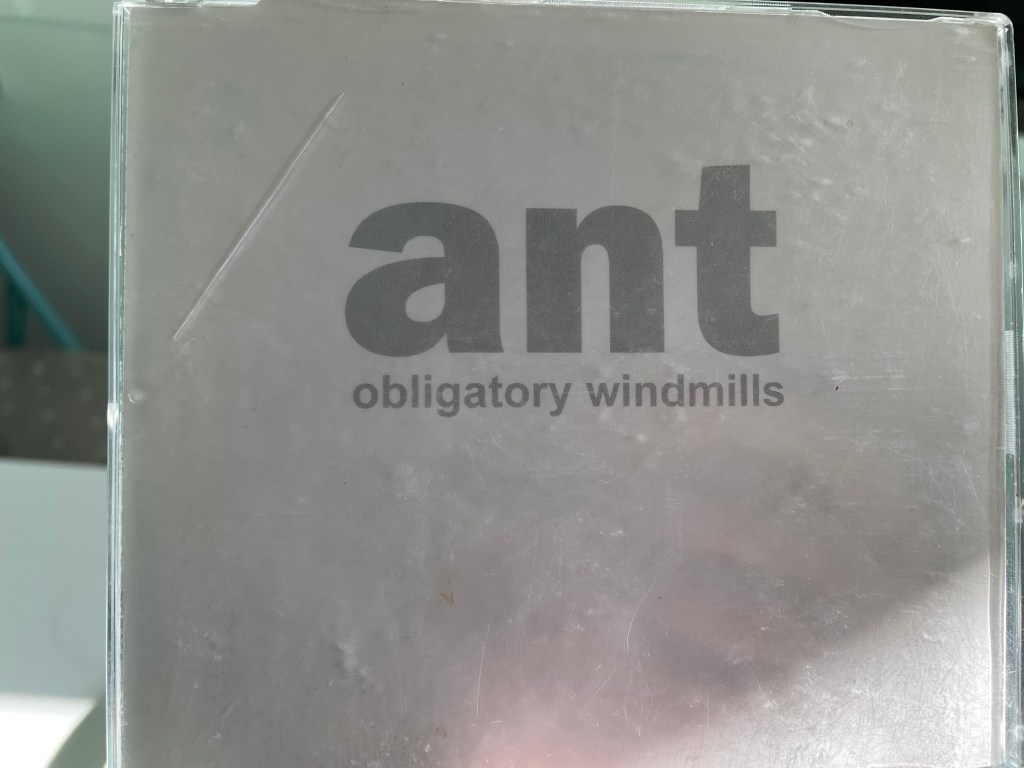
Obligatory Windmills by Ant Parker: 25th Anniversary.
n.b. This is a reflection on the e.p. by Ant Parker and how it develops themes from his earlier work with the band Why?
Obligatory Windmills is the e.p. that musician Ant Parker recorded not long after his influential folk band Why? released Happy, their excellent final album. In many ways the e.p. is an eloquent distillation of the band’s oeuvre, including Northern European night journeys over land and by ferry, reflections on faith within and beyond organised religion, and wordplay in abundance.
Opener Walking the Street evokes the atmosphere of long distance travel outside holiday season, with the tone becoming gradually darker and more mysterious as the narrator moves east: ‘It won’t be long till we’re held captive by the darkness, but it won’t be long till we’re set free.’ We’re taken to Amsterdam, with a distinct note of caution in the voice, to Hanover and finally ‘Eastern Europe on the night ghost train to nowhere…we arrive before the sun on the horizon.‘ I’m sure I read an interview with Ant once in which he said if he wasn’t a songwriter he would be a poet – with these lines, we can easily see why: that beauty in the paradox of arriving nowhere, the endless cycle of the sun rising and setting. Journeys by boat and on land, for example through ‘many short Stena line nights’, ‘into Wells down the A39’, and ‘through the fog to LHR’, are recurring motifs in Ant’s writing and are particularly atmospheric on this song where the curiously unpopulated streets heighten the loneliness of the homesick touring musician or travelling worker. To me this is reminiscent of W.G. Sebald’s narrator in Vertigo who ‘had no alternative but to take the night express across the Brenner’ and who in the poem Please, as translated by Michael Hamburger, asks for the ‘brown overcoat from the Rhine Valley in which at one time I used to ramble by night.’ The ominous tone of the chord changes are complemented perfectly by a voice that blends anticipation with uncertainty as the night grows darker.
Second song Hidden Power combines humour with serious reflection on what it means to look for signs of God beyond the confines of a church building, continuing a lyrical theme from Why? days, for example in the song Three Short Stories from the album Giggle: ‘It’s easy on a Sunday when you’re sitting with your church mates; sometimes I need to talk to God outside his business hours! ‘
In Hidden Power, the line ‘I thought I saw you on the television: 3 in the morning on OU revision’ has to be one of my favourite lines from any song, the nocturnal setting established by Walking the Street is consolidated by the confusion of a baffling night time Maths or Physics lesson, managing also in its perfectly balanced rhythm to find a rich vein of nostalgia for a time of shared cultural experiences liberatingly limited by a narrow band of TV options.Ant Parker’s vision of what it means to be important is perhaps the central message of all Why? albums and this e.p. It was signposted in the liner notes of Rachel Says Boo, their first album, with the phrase ‘It’s nice to be important, but it’s more important to be nice’ featuring prominently. I would perhaps summarise their recurring message as ‘Everyone is equally important so please treat yourself with the respect you deserve and extend that to other people.’ In Hidden Power, we realise again that Ant is not someone who would doff his cap to somebody on the basis of social status, whether that’s underneath the ‘decrepit steeple’ of the church or in ‘public places’ where we see ‘the doctor with his rainbow braces.’ This is pure speculation, but I wonder if this sensibility is heightened by having lived in towns and villages in Somerset and Devon with relatively small populations; perhaps the perceived status and prestige of certain local figures becomes more pronounced and oppressive than it would in other places.
The up-tempo family affair ‘It’s Probably True’ was written by Ant’s brother, the outstanding songwriter Nick Parker (http://nick-parker.co.uk), and includes a reference to their father, the amazing Neo-surrealist artist Norman Parker (https://np.01458.com). The ultra-inventive lines include ‘It’s probably true; I serve faster than Krajicek. It’s probably true; I cry ‘check’ before Kasparov.’ By mentioning so many people who are experts in their fields (‘I mow my lawn better than Titchmarsh’) the arrogance of anyone whose ‘ego’s gigantic just like the Atlantic‘ is skilfully exposed, but in a life affirming rather than a judgemental way. Obligatory Windmills is a critique of arbitrary pride and social convention; it heads north and east when others might go south, looks for the divine in odd places, destroys the ego through joy and finally, on Little Girl attacks the social pressures which confront children: ‘Caught up in…the moment, so-called friends will tell you it’s ok: but it’s not OK.’ Why? were always unafraid of being counter-cultural, using their platform to generate unbelievable amounts of fun, energy and lightheartedness, while also warning against the opposite ‘because the drug that you thought would lift you high drags you down…and you wish you could start your life again like a child.’
The reflective tone and distilled wisdom of Little Girl is in a similar vein to the ballads Game of Life and Nil Score which closed Why? albums with extended reflections on the absurdity of life, along with some philosophical conclusions to draw upon in response. Perhaps they were the band’s unique versions of a blessing and commission at the end of a church service. For example, from Game of Life: Putting ‘somebody’ down on a triple word score, 7 i’s coming out of the bag. Today is today, yesterday’s gone, tomorrow we’ll start something new is an absolutely ingenious way to show us via Scrabble that sometimes things just don’t go your way, so move on: or perhaps that if you use ‘somebody’ for personal gain, the universe may mock you with the instant karma of replacement scrabble tiles which reveal your ‘me, me, me’ approach in all of its futility. Games condense life’s fortunes: ‘Every ladder we climb has a snake at the top waiting to bring us back down…’ but while enjoying life for yourself, remember to extend the pleasure to others: ‘Along the way take time to smell the flowers and send one up to those living in city towers.’
Obligatory Windmills is testament to a brilliant songwriter and wordsmith, synthesising many of the themes presented throughout the 90’s by Why? I wonder if Ant will produce a follow-up over the next 25 years, or maybe a 50th anniversary double header with an additional disc, for example: Optional Turbines, Negotiable Hydroelectric Power Plants, Mandatory Biodiesel Coffee Grounds, Ethical Grounds for Hell: Smooth Roast, Slain in the spirit: buoyed up by Keema Naan, Premortal Crumpet, Interdimensional Waffle?
-
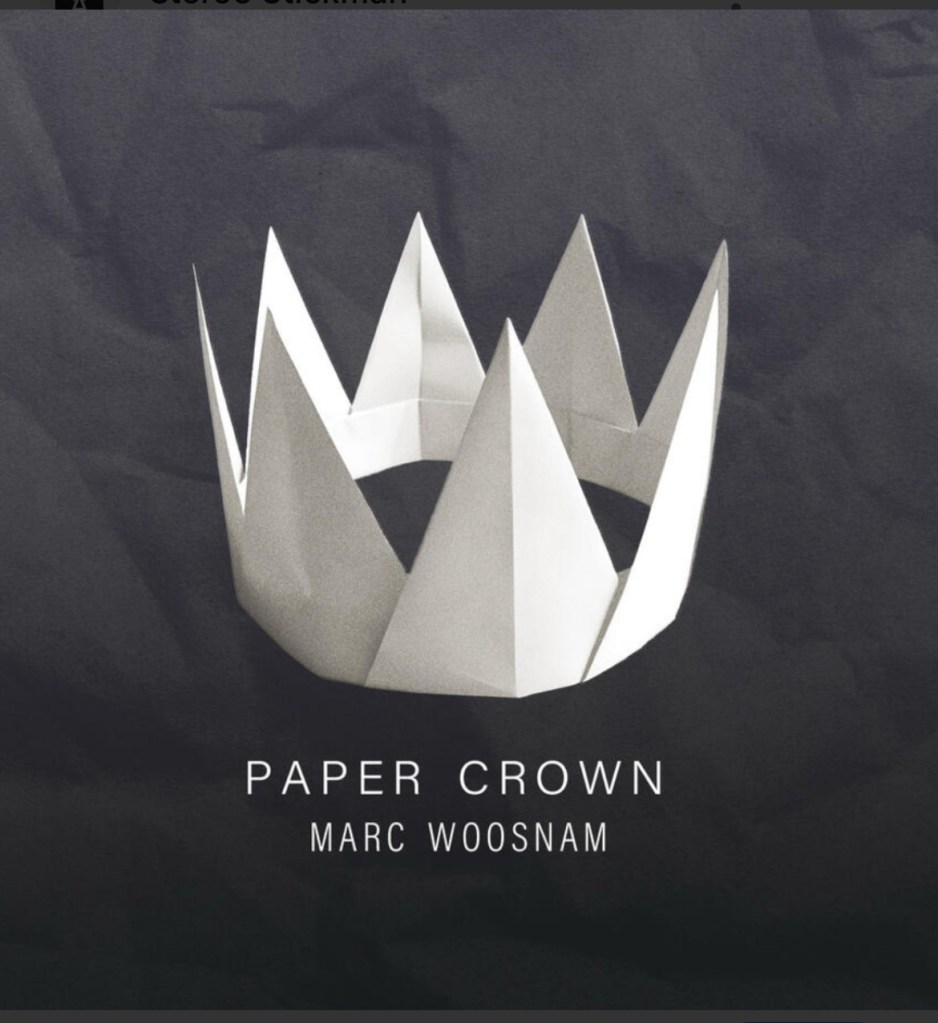
Authoritative Vulnerability: A Review of Paper Crown by Marc Woosnam
Marc Woosnam’s Paper Crown begins on the rainswept streets of North London with a potent cocktail of place and atmosphere in Angel Islington, documenting a promising start to a relationship which soon turns sour as a dark and haunting undercurrent begins to prevail – this is a very well crafted cyclical vignette of how uncontrollable forces can corrupt even the best of intentions. This is powerfully followed by Therapy, one of the singles that had been pre-released ahead of the album, communicating with visceral emotional honesty the feeling of being misunderstood while fighting against the responsibility to pretend everything’s progressing (especially in the context of a real therapy session where time and money’s involved): ‘I’m not getting better/It’s flawed from the start/ I’m not getting better/ I’m falling apart. I’m out here exposed…‘ are some the most powerfully delivered lines on the album. As a listener, you’re faced with the stark reality that entire systems of belief and practice may be undermined by a slight fault in the initial premise, a theme that continues throughout the album. We believe every word of this, and that’s typical of all Marc Woosnam’s releases; there is never anything affected about the vocals, lyrics or instrumentation – nothing to dilute the sincerity of the words.
Endless is a song on an epic scale, visually arresting and with a filmic quality which parallels the opener, with ‘tears in the rain’ a subtly integrated Bladerunner reference connecting rain with a sense of being lost in time, compounding the atmosphere introduced by Angel Islington. The uptempo Confelicity follows, consolidating the focus on relationships, a theme presented beautifully by the duet Collide in which the central character, with Woosnam’s trademark authoritative vulnerability, admits ‘I thought I knew how to see, but I’ve been blind/ I thought a battle was a war but it’s just pride/ Now I understand it’s just where we collide.’ Anna Stewart’s voice subtly emerges through the initial backing vocals then takes the lead with great depth and potency – let this song seep in and I feel it has the power to affect thinking and conduct for the better.
Those well versed in the album will notice I haven’t mentioned Imposter, one of the songs sandwiched between the previous two mentioned. This, to me, is a lyrical masterclass in its honesty and irony. Again, the narrator’s confessional tone is punchy and real rather than weakly sentimental: ‘I’m just an imposter, a fake and a fraud, but I’m out here trying to keep my facade…‘. The subtle melody shift on ‘facade’ compounds our understanding as listeners that it’s those with the most sincerity and honesty who are most likely to feel at fault or even have a sense of imposter syndrome. We can all think of people who act with impunity and terrible self-importance, but who wouldn’t for one moment deem themselves to be ‘imposters’. That’s the irony of the song – we disagree while agreeing all along. Tying in subtly with this theme, we are then shown a genuine imposter in the song Prosperity, a critique of those who line their own pockets and promote their own reputation (and facade) in the name of religion or a noble cause while the unwitting sponsor ‘private jets and fancy cars’ and ‘make the preacher a TV star.‘ The placement of this song is perfect – the previous songs mean the plank (speck) has been well and truly removed before the speck (plank) is targeted in the eye of the preacher.
‘Bliss’ continues the dark and increasingly haunting tone with elongated vocal phrases, reminiscent of Nirvana, leading into the refrain ‘fire needs a fuel‘ which echoes over a rich cyclical chord pattern. Folly of Fools follows with another image of darkness, beginning on ‘Sunday morning at 3am.’ There is a duality to this, with the question ‘Who was I when I was where I shouldn’t have been’ creating an image of the character shapeshifting in the dark like Jekyll and Hyde, ‘a mirror showing just who is the profiteer.’ This also has a striking middle section where an echoey voice sings of ‘…the restless twilight, dwelling on my shadows deep and long.‘ The theme of duality is compounded by the final song ‘Push/Pull’ which, though it speaks of ‘the same old sad song, the same melody’, again contains the irony that hope, joy and even lightness exists in the very substance of unvarnished expression once pretence is stripped away.
On that note, the album perhaps finds its lyrical centre of meaning in Lords and Ladies (a song which initially reminded me of Crash Test Dummies’ Knights and Maidens, if only due to the upper class social milieu conveyed by the title), a culmination of the theme of honesty vs pretence built up throughout the album. The ‘paper crown’ of the title is evoked here as ‘crowns of paper, thrones of air…’. Deconstruction of pretence and privilege is astute and calmly observed rather than loaded with despair or excessive bitterness: ‘You think you’re OK – the deck’s stacked that way. You loaded the dice.’
While there are some dark thematic undercurrents to this album, these serve to convey psychological richness and an integrity of voice which ultimately finds hope and a sense of liberation in the exposure and rejection of many forms of social artifice. Paper Crown is an album of subtle lyricism and emotional depth which contains immediate pleasures and thoroughly rewards repeated listens.
https://open.spotify.com/album/0YyvBEKe9hZghk0bX2AR7d?si=TZWHOtv9RJuHi6b2qvH_dg
-
London Grip Magazine

‘Half a thought for Hamish’ has been included in the autumn edition of London Grip. It was initially submitted (unsuccessfully) for the summer edition but I’m grateful to editor Michael Bartholomew-Biggs for suggesting a resubmission in June for this month’s magazine. I didn’t change anything, so I imagine it must have been deemed to fit better with this month’s poems (introduced below). The poem was written with a very specific setting in mind, which is the Windsor side of Eton bridge.
N.b. There currently seems to be a problem with the link below – poem posted here in the meantime
Update: All London Grip data from Autumn 2023 to Autumn 2025 is currently lost
LONDON GRIP DATA LOSS: RESCUE PLAN – londongrip.co.ukHalf a Thought for Hamish
Spare half a thought for Hamish McGinty,
his boots spattered by river mud,
geese and sea birds peppering his temporary table
under the sky’s off-white Sunday.Spare half a thought for Hamish,
his grey and white head
smiling without direction.Spare half a thought,
he thinks, if you can,
but for what?Spare half a thought for Hamish McGinty:
those river walks he’ll never vlog.
This is the man without subscribers.Spare half a thought for Hamish,
caught between Mephistopheles
and the raging salt chuck rails
of The White Stuff; half local,
half tourist – both parts mystified.Spare half a thought when the dawn means nothing,
when you’re clambering around sealed boxes
from the past on the lorry of the mind and heart.Spare half a thought for Hamish McGinty.
He restrains himself from talking:
would do so if you asked him.The mind isn’t ‘out there’ for him yet
on communal pavements – you wouldn’t mentally file him
as another babbling shipwreck.Spare half a thought for Hamish
when he has no satellite pre-sets
or passengers for the road ahead.Spare half a thought
as he gets up from the table
and over the bridge past Wren’s hotel,
an ancient church and the reliable indefinable
grey and violet of the river.Spare half a thought for Hamish.
No-one can search his catalogue of the present
from a distance and click some heart. Spare a thought.,
x
-
Just Burial
Unfortunately we’re booked up, sold out –
all the major graveyards and burial grounds,
odd patches of land and even driveways
people used to book on our app
are resting places of people squashed together
like faded burgundy landfill coffee cups.
In fact, ‘Just Burial’ has gone into liquidation.
Where we used to charge the earth
we’re undercut by conglomerates of ash.
They keep your memorial in the cloud
just as safe as if you were in the ground.
No fragments to reassemble on ascension,
no odyssey of the skull, but a 64-bit virtual mansion
forms the many rooms of our father’s house.
 Wilderspool Causeway