Wilderspool Causeway

  • Home
  • About
  • Contact
  • Poems

  • Caversham Trents 6 Wokingham & Emmbrook 7 (Davis 3, Saynor 2, Mulcahey 2) Cemetery Junction

    You can’t accuse our coaches of failing to innovate. They will take a defeat on the chin and, rather than railing against the elements or tearing strips off the players, calmly retreat to think through what happened, why and how we can change.

    Paul is currently doing a course called ‘Creativity in Football’ so it was perhaps no surprise when before the game he gathered the players into a tight circle to pour over what I can only describe as ‘Rothko Charts’, blocks of colour denoting sections of the pitch to indicate where players should be during various phases of the game.

    It seemed to tap into the mathematical sides of their brains, a little puzzle they engaged in with relish. I wasn’t entirely sure what the strips and cubes meant, but hands were shooting up in abundance.

    The first game of the Summer League, as some may remember, was disastrous so we had to go back to the drawing board. Since that game, the team have played in a Christmas Tree formation, heavier at the base (defence) and lighter in attack, winning twice and drawing once.

    One of the main tenets of the ‘Creativity in Football’ course is to limit the information given to children, so as not to ‘coach them out’ of their instincts. I suppose the information you do give, therefore, has to be good. The Rothko colours seemed to remind them of the idea of playing in a pattern.

    The grass pitch they played on seemed to be suffering slightly from the effects of the weather, lack of gardening and too many dogs. Long grass in the corners held the ball up, creating a more fluent game on the one hand, as the ball was in play more, and a sense of rugby scrums and rolling mauls on the other as players sought to move the ball forward.

    We laid seige to their goal with several near misses before Caversham scored with their first shot, against the run of play. ‘Keep up the pressure!’ yelled one of their dads. I couldn’t (or just didn’t) resist firing back ‘What pressure? That was your first shot!’

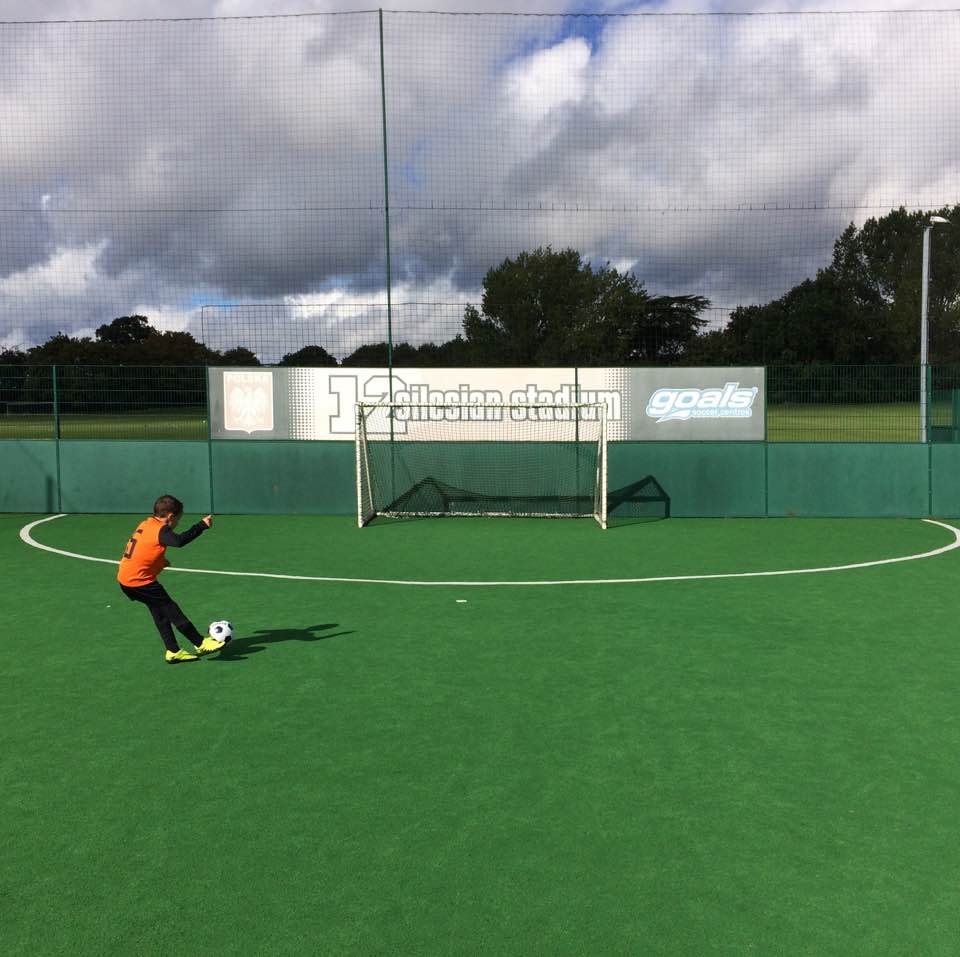
    Wokingham went back on the offensive and won a free kick soon after, which Evan lined up to take from a narrow angle at the edge of the box. I knew he could score from that position, but superstition held me back from filming. I just felt that if I filmed it, he would miss. He curled it into the top corner before we added a further two goals with excellent finishes from lone striker Joel Davis, the angel at the top of the Christmas tree.

    Controversy followed when Davis cut through the defence again and hammered the ball into the net. It also caught the underside of the crossbar and the ref felt that it hadn’t crossed the line: part of the net behind the goal is tight to the bar, meaning the ball could hit the net behind the bar at high velocity but still not technically cross the line. That’s why all goal nets at professional grounds are uniform now; the ball sails into the net without impediment.

    Crossing lines. For some reason (perhaps due to having crossed Sonning Bridge perhaps over 1000 times), I always visualise the Caversham parents’ journeys to the game. Did they choose Reading, Caversham or Sonning Bridge? Taking it a stage further, I think about a reported scuffle on Caversham Bridge in 1643 between the Royalists from north of the river and the Parliamentarians from the south. In my mind, us folk from the nondescript tyre outlets and roadside garages of Emmbrook are still the Republicans against the Royalists from the herb gardens and tree lined parks of Caversham. Ridiculous, I know. It’s a match between complementary sets of 8-year-olds, united among the grills and gravestones of East Reading.

    Usually, when there’s a moment of perceived injustice in the game, there’s also a sinking feeling and a question: ‘Will we have to pay for that?’ It looked as though we would. By half-time, it was 3-3 and early in the second half the perceived Royalists added another.

    What followed was perhaps the best goal I’ve witnessed in person.  Before you say ‘So?’ (in the knowledge I’m a Fulham fan), please bear in mind that I’ve seen Pajtim Kasami score at Crystal Palace. And before you laugh, please note that his goal was nominated for a Ballon d’Or, meaning it was regarded as one of the top twenty goals in the whole of Europe that year. It’s hard to describe Callum’s (Connor’s) goal, except to resort to cliches like ‘mazy dribble’, ‘defies logic’ or ‘Messi style.’ He just ran around everyone, with incredible skill, and at the point at which you expect to say ‘Well he did the hard bit’, he slotted it home with class.

    Despite that, the game seemed to be going in Caversham’s favour. Is this anything to do with the fact that they’re based at Mapledurham playing fields, 92 metres above sea level, and therefore have better lung capacities than those of us battling asthma down by the M4? Probably not, though buffer zones of greenery are probably more valuable to them than us. Callum constantly read the game like a master, determinedly tracking back to defend before rampaging forward to create play down the left. At 5-4 down, he squared the ball to Evan who picked his spot and hit the ball high into the goal to level the scores again.

    The final passage of the game could not have felt more fitting. Again, we were caught out at the back. Questions have to be asked, no doubt, but with the score at 6-6 with a minute left, Davis – cruelly denied earlier – was put through to a one-on-one with the keeper and calmly completed his hat-trick.

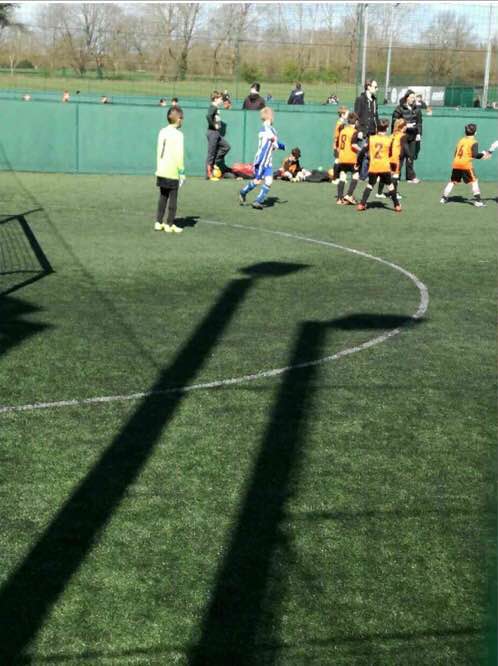
    A pitch invasion in Reading – of a better sort to that witnessed on Tuesday night – followed the final whistle. The coaches’ adaptability and creativity was vindicated and reflected back on the players as they gathered again in a close knit group with fists crossing, the elastic of the ‘Player of the Match’ wristband stretching to surround them all.

    18581635_10158712136235652_1342046007566799702_n


    May 20, 2017

  • Wokingham & Emmbrook Oranges 6 (A.Mulvaney 2, C. Mulvaney 4) Wokingham and Emmbrook Oranges 4 (Sexton 2, Saynor, Xanthoulis) La Bambonera

    ‘He has the bonhomie of a gameshow host and his handshake is so limp it’s like meeting a ghost. He lies through his teeth with impeccable grammar; in the game of life he’s just a dreadful goalhanger.’ One of Billy Bragg’s rare forays into football imagery sums up the divide between those who play for themselves and those who play for the team. He’s brings a dull point to life, that’s for sure – as did the players of Wokingham & Emmbrook Oranges today.

    This training match, with no common enemy, had the potential sourness factor of a Tangfastic. The tension was palpable. Why is that? Infractions included: hitting the goalkeeper after a soft goal was conceded, a lunge at an opponent which Jonathan Edwards would’ve considered promising, disruptive crying, and apologies which were about as natural as a forced simile.

    Where did all the angst come from? Do children carry baggage from the past, as adults do? Back to Billy: ‘He was trapped in a haircut he no longer believed in. She said “I’m a teacher here; I teach the children.”‘ Is the implication here that the vitality of the children brought the teacher into the present moment, whereas the man – as indicated by a Top Gun flattop or something – just couldn’t get there? Or is being ‘in the moment’ actually a major problem for children, and therefore overrated?

    Whatever the reason for the turmoil, they would rather lose against strangers than against each other, despite some excellent goals, good play from most players and nothing riding on the result. In terms of the adult haircut dilemma, some thoughts from Stephen Malkmus:  “And in a funny way, the shaving of my, uh, head has been a liberation from, uh, a lot of, uh, stupid vanities really. Uh, it has simplified everything for me. It has opened a lot of doors, maybe.”

    18222538_10158643165620652_1409829052753450909_n


    May 6, 2017

  • Barton Rovers 0 Wokingham & Emmbrook 5 (Mulcahey 3, Selley, Davies (pen) BYDL Summer League

    The team are still trying to acclimatise to new, larger pitches which are in a sort of urban boondock between Wokingham Road and an indefinable building you could probably pop into for a bit of psychobabble or group therapy.

    We had a wander around the building to locate some facilities, but even the steward directing us had no idea as to what it’s actually for. It has the clinical atmosphere of a hospital, but without any attempts to throw sterility into relief with the presence of an overpriced M&S outlet or an AMT.  Instead, it contains bewildering signs: ‘Intermediate Development Pathway Room’, ‘Dissociative Conversion Studio’, ‘Autologous Salvage Area.’

    Instead of incremental progress, our coaches opted for a complete overhaul of formation and tactics after last week’s fiasco against Caversham Trents. Training almost contained Felix Magath levels of direct intervention, albeit without the application of cottage cheese to sore limbs.

    Free flowing attacking football was to be sacrificed in favour of a Christmas Tree formation. Further research reveals that coaches Martyn and Paul had instigated Karl Rappan’s Verrou, an early form of Catenaccio, the ‘door bolt’, a defensive tactic which employs a free roaming defender to troubleshoot across the back line and initiate counter attacks. For most of the game, this role was the domain of top goalscorer and heartbeat of the team Callum Mulcahey, who also doubled up energetically as a mezzala (box-to-box midfielder.)

    Evan played as a terzino fluidificante, or ‘wing back’, tackling and intercepting well before making probing runs down the wing; he also went close with two free-kicks, one of which hit the bar and one of which was saved to the keeper’s left. Kelly Bond played as an effective mediano, while Annabel Mulcahey was the left-sided fluidificante who also offered bullet throw-ins reminiscent of Rory Delap rather than the misdirected loops of other teammates. Mario Selley was brilliant as a seconda punta fantasista, making purposeful runs into the box to anticipate passes from either Mulcahey or Thanos Xenakis, a marcatore puro who roots out problems in the midfield with the vigilance of a sniffer dog at Schiphol airport.

    As for Barton Rovers, quite who they were or where they came from was a mystery. Apparently they were Luton & District League Division Three champions in the 1947/48 season and won the South Midlands Floodlit Cup in 1989, but surely this was a different Barton Rovers? The first guy I asked seemed to have come down from the north to watch his nephew, and didn’t have much idea about the team. His brother, the boy’s father, was friendly enough but couldn’t offer much more than ‘they are a long established club.’

    Whoever they are, a 5-0 win following a swiftly implemented tactical revolution showed fantastic versatility from the players. Is talk of a Summer League title challenge still slightly premature? Possibly, though I’m just about ready to admit last week’s score by revealing that after two games our goal difference is -15.

    April 30, 2017

  • Wokingham & Emmbrook 3 (Dance 2 Mulvaney) Reeves Rangers 5

    After a barren run which is now officially longer than The Grateful Dead’s encore on New Year’s Eve 1978, we lined up against Reeves Rangers, under a punishing sun, for our final game in Woodley.

    ‘I HATE this team’ reflected Jack’s dad, a mild mannered vegan from the Black Country. My thoughts were not dissimilar, but your perspective will depend on what you think of ‘anti-football.’ Is there a style of play which, though within the rules, is worthy of condemnation?

    Thinking back to ‘Crazy Gang’ era Wimbledon, I remember admiring how a small club from South London could rise from non-league to topple one of the best Liverpool sides ever and win the FA Cup.

    When you look into their story more closely, however, you realise the extent to which their success depended not merely on a liberal interpretation of the rules, but on a none-too-inconspicuous degree of criminality.

    The dressing room culture was designed to eliminate any trace of weakness. John Scales’ car was torched as a ‘prank’; as a semi-reasonable human being, he didn’t quite cut the mustard in the eyes of Wally Downes, Vinnie Jones and John Fashanu, whose wrong sides could take you down avenues from which you would struggle to emerge.

    When the ball’s in the air, the contest is physical – a fight to see who can gain control of it as it drops. If you’re willing to punch, elbow, bollock tug…you’ll get it. Reeves Rangers made the ball into an Alpine Accentor (a bird rather than a dodgy computer or model of Honda, believe it or not), propelling it so high it appeared to merge into a cumulonimbus backdrop, only then to drop in time for a striker to steer it home from the ‘mixer’.

    It’s hard to play football when the ball’s twenty feet above your head – it’s obvious that you have to play the man rather than the ball. For Wokingham to adapt their tactics to do this, though, would be nigh on impossible. At the best of times, calling to the players is tantamount to trying to whistle a fling of whimbrel in from the sea. The sound gets lost and even if it didn’t, it would be filtered through an 8-year-old’s brain to basically mean the square root of f’ all.

    Reeves won with time to spare, despite a footballing fightback from Wokingham which brought the score back to 3-2 and led to dominance of possession in the second half, a futile stat when faced with the ultimate short-termism of the long ball.

    Anyway, as a post-season reflection on his teammates, I decided to deliver Evan the exact questions put to Ryan Sessegnon in the Fulham v Ipswich Town programme this week:

    Q.) Who would you least like to fight with?

    Evan: Josh because his dad’s very tough.

    Q.) You have £100. Who would you buy a present for?

    Evan: I’d buy Connor some trainers because he wears rusty Tiempos at the moment.

    Q.) Who’s your best mate at Wokingham & Emmbrook?

    Evan: Mark because we grew up at nursery together.

    Q.) Who’s the teacher’s pet?

    Evan: Me because our coaches are better than the other teams’ coaches. All they do is get their teams to boot it, but our coaches teach us to do skills and not boot it.

    Q.) Who has the worst haircut?

    Evan: Can I base that on a player who isn’t in our team? Balotelli.

    Q.) Which player is management material?

    Evan: Um, I think Mark because he knows what to do but never actually does it.

    Q.) Who would be most annoying to be stuck in a lift with?

    Evan: Ciara because she’d be chasing me around the place.

    Q.) Which player is the vainest?

    Evan: Me because I love to see what I look like and if I look bad or not.

    Q.) Who’s the easiest to wind up?

    Evan: Ciara. Every time I disagree with her she cries.

    Q.) Who would you ask for help in a quiz?

    Evan: Amelia because she knows almost everything. If it was a maths quiz I’d pick Jack because his dad’s a Maths teacher.

    Q.) What’s your favourite memory of this season?

    Evan: Scoring the first goal of this season and the season before.

    Q.) What are the team’s aims for next season when it’s 7-a-side?

    Evan: This is a target for the coaches: stick the players in the positions they want to play in or are best at.

    17862466_10158504299170652_4674634628605827596_n


    April 9, 2017

  • Centre Skills of Tilehurst 8 Wokingham & Emmbrook 5 (Mulvaney 5)

    As we assembled for the anthem ceremony, it seemed as though something was rotten in the state of Tilehurst. For a start, only three of the West Reading outfit had choreographed their mornings with a view to starting a football match at 11:30. Of those who were present, two were either generally insane or had taken a polystyrene bodyboard – emotionally speaking – to surf the Pipeline of youth football. One lad was on the floor in tears and one was in need of a touchline courage transfusion to walk the final desperate yards to the pitch.

    When I say ‘anthem ceremony’, that’s what I think would be an appropriate assertion of identity prior to kick-off. We could belt out Men of Trowbridge: ‘Loud the martial pipes are sounding/ Every manly heart is bounding/ As our trusted chief surrounding/ March we Trowbridge men. See they’re in disorder/ Comrades, keep close order/ Ever shall they rue the day/ They ventured o’er the Wiltshire border.’

    Wokingham cognoscenti will know that Cross Street, outside The Ship, used to mark an unlikely border between Berkshire and Wiltshire. Perhaps Centre Skills would opt for an East 17 classic: ‘Good times we had return to haunt me/ Though it’s for you, all that I do seems to go wrong. STAY NOW! Baby if you’ve got to go away, don’t think I can take the pain, won’t you stay another day?’

    When the ref, with West Coast nonchalance, lackadaisically brought the whistle to his lips to start the game, Tilehurst had somehow scrambled a team together which would soon be joined by a sub – young Bernard – who would make a strong impression on the second half.

    Unfortunately for Tilehurst, Connor defied precedent by firing us into an early lead, sending their keeper into a bawling heap at the edge of the box and their manager, yet again, into his store of emotional sticking plasters.

    After 10 minutes, with Evan in the Pirlo role, Josh tearing around the pitch to win tackles and Connor finishing in style, we were 3-1 up. In most games, that would be ‘job done’, but to say our defence is like a sieve would be an insult to the kitchen implement which at least retains something of worth and energy as it conducts its business.

    In the second half, with ‘Dribble, Bernard!’ the mantra from the Tilehurst bench, Wokingham capitulated like an aunt among Parma Violets while Centre Skills, with increasing emotional fortitude, began to flourish in Bernard’s mazy slipstream.

    17757183_10158459984490652_1090151842971684032_n

    April 2, 2017

  • Caversham Trents Royals 4 Wokingham & Emmbrook 3 (Mulvaney 2, Dance)

    The River Trent, the ‘mere of England that divides the north part from the south’, is a major river, ‘smug and silver’, running through arguably the most important place in the British Isles: Burton-on-Trent. The Emm Brook, by contrast, is a lethargic tributary of the Loddon, idling alongside the motorway with intensive behaviour support from Thames Water and council drainage manager Eddie Napper.

    Given the gulf in class between the two water courses, I’m sure you’ll agree that the scale of defeat was commendably marginal. They are from the big leagues; we’re a tributary of a tributary.

    As the morning progressed, the prospect of witnessing a Wokingham & Emmbrook win receded into the hazy distance. In fact, it had begun to seem impossible. Admittedly, the primary reason for this was that at the time of kick-off I was halfway to Ginster territory, cruising through Wiltshire on the westbound carriageway of the M4 to play for a place in the final of the FA People’s Cup.

    Back in Woodley, Wokingham & Emmbrook started with footballing abandon, playing a high pressing game of power and panache, undermined on 6 minutes by the Royals’ number 24, bespectacled Charlie.

    Two minutes later, Connor ripped apart the right flank with a truly damaging run before scoring a fortuitous equaliser on 11 minutes. Josh, playing like a goaded beast of the field, saw a shoe fly off as he hit the ball with extramundane venom, compromising health and safety protocol as he sent us into the break with a narrow lead.

    Caversham approached the second half as if Neil Warnock had destroyed their changing room and sent them out with one last chance of a contract: one last chance at life. They powered forward as if the Trent had been re-routed through a tributary of the Thames, breaching our defences soon after the whistle with a goal, the nature of which I do not know.

    Such was the relentless Caversham pressure, they soon scored again but it should be noted that the ref seemed to be in flagrant dereliction of duty as he neglected to force the Caversham players to retreat to the halfway line for our goal kicks.

    The irrepressible Connor Mulvaney and co. wouldn’t capitulate to Caversham without a fight and drove forward with Evan in attendance, scoring to reduce the deficit to a single goal before Evan’s late attempt at an equaliser was saved by a goalkeeper of unknown appearance.

    This was a great performance from the chaps and chapettes against one of the strongest footballing tides in the affairs of men, representing a fitting prelude to (the outrageously good) Mulvaney senior firing Wokingham District to the final of the FA People’s Cup on April 3oth.


    P.S. When I asked Evan if he’d rather I watch his game or play football in Bristol, he said “Please play, dad. Then you won’t have to write one of those report things” (this was more about perceived Wifi/computer access issues than fear of the limelight, though.)


    17353324_10158434635640652_2907759999625261826_n

    With thanks to Caroline Saynor and Andrew Parry

    March 27, 2017

  • Caversham Trents Blues 14 Wokingham & Emmbrook Oranges 2 (Mulvaney 2)

    image
    Team talk


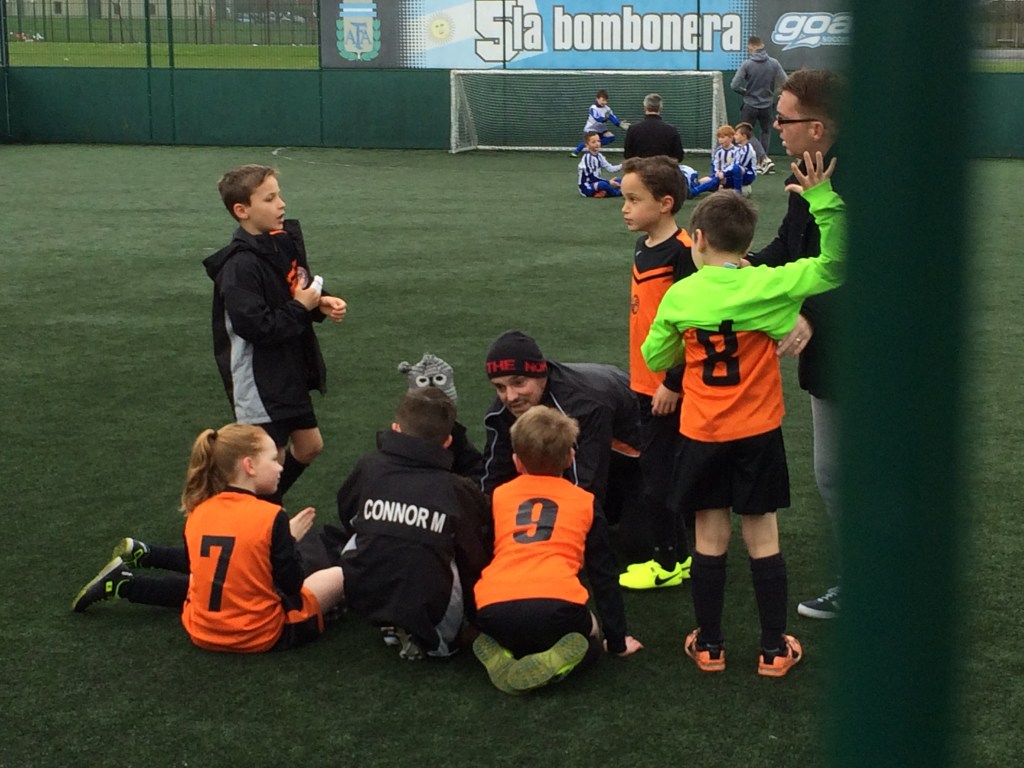
    ‘David Fairclough never cried.’ Coach Michael’s closing rebuke, buried in Scouse folklore, was probably designed to fall on deaf ears. A true estimation of the footballing and emotional weaknesses on display today would have been too much to bear, like looking into the face of God is supposed to be.

    Previous encounters with Caversham have generally been more favourable (even including our best ever result: an 11-0 win in which Evan scored a hat-trick), but today Wokingham & Emmbrook went to pieces in such style that the main parental and coaching objective was to spot who was next for the emotional quicksand. Three players dissolved into tears mid-game, one of whom resisted substitution with the determination of Swampy holding out against the Newbury bypass, face contorted against change.

    Perhaps this reflected Wokingham’s outlook in general: meandering and philosophical. Driving down Miles Road before the game, I mentioned that on Wednesday I ran along it as part of a strange Woodley loop which ended in horrible stomach cramps: “What were you running from?”, asked Evan. Nothing,  I replied (though that wasn’t entirely true – I had spotted a former colleague pulling into the Loddon Vale Tesco Extra car park I started from).”OK. Were you running from or to something?” Neither. But did he have a point somewhere, albeit unwittingly?

    Though it wasn’t evident on the pitch,  Caversham had their own crisis to contend with before choosing their Saturday bridge over the Thames, probably opting for the big boy: Caversham Bridge itself. In midweek, their best player thumped a teammate in the face and was therefore suspended for today’s action. Their moment of catharsis was in the past, now, and seemed to have been distilled into a sense of common purpose characterised by ruthless and fluent football.

    After the game, as already noted, the coaches couldn’t quite approach today’s play head on, and nor can I. Instead, they ranged across the years for useful analogies. We needed to be more like Wimbledon in 1988. We needed to be more stoical, like David Fairclough. We needed to remember Pat Van Den Hauwe (in my opinion) – he didn’t cry either and to this day he takes care of Everton’s walking footballers, holding his head high in the launderettes and bakeries of Bootle after leaving the questionable dealings and unfortunate diseases of the murky underworld behind him to embrace a new future thanks to the support of visionary Toffee Denise Barrett-Baxendale.

    We might as well let it out; turn the experience into a watershed, catharsis, wholesale renunciation of football. Perhaps the only way to rebuild is to truly collapse, to lose your way completely in the cul-de-sacs of Reading’s south-of-the-river suburbs, succumbing to at least two of the four horsemen of the apocalypse, kites and blossom notwithstanding.


    Post-script: an extra training session was called today near Marjorie’s tree, Cantley Park – Aslan is on the move.


    March 18, 2017

  • Burghfield Lions 4 Wokingham & Emmbrook 2 (Mulvaney 2) Lokomotiv Stadion, Moscow

    Orchard tractors and rotary tillers rumbled down the A33 from old water meadows and Osier beds low in the valley of the Kennet, signalling a suspension of agrarian practices for the people of Burghfield as they prepared for a morning meeting with Wokingham & Emmbrook on neutral territory.

    Phlegmatic. Standoffish. Emotionally unavailable. The Burghfield manager seemed destined to connect with us only on a superficial, ‘footballing’ level. What makes him tick as a person and the currents which brought him to where he is today would remain largely unknown, buried beneath West Country dialect.

    What he did bring with him, though, was a sense of the vast open spaces of Wessex, suggesting an affinity with the Magnas, Abbases and Regises to the west of the county rather than the Homebases, Kwikfits and Lidls of the middle.

    Burghfielders circumvent the urban, where possible, with rare trips to Reading following the path of the Holy Brook rather than the becalmed traffic of the A329. It was little surprise, then, to hear the Prime Villager enjoin our manager to embrace the Baltic expanses of the 7-a-side pitch at the far end of the Bulmershe: “Alright me babber? We don’t want to be on no small pitches today mate, right? All that bloody narration from that spanner from the league about what pitch we’re on’s proper done me ‘ead in mate. And it’s a quick handshake ahfter as I’m off to Banjo Island to see the Gas.”

    West Country riddles aside, we wandered towards Russia in the hope of transcending the frigid tactical landscape of last week’s 2-2 draw with Wokingham & Emmbrook Rangers, a game in which both sides stumbled on the foothills of their hopes, failing to inhabit the enlarged dimensions of the pitch with sufficient authority to signal much evolution in footballing style.

    This week, the auguries were better. Our defence, usually about as safe as a Mongolian mineshaft, lined up 3 strong for a change and failed to concede until the 19th minute, a fact which Connor Mulvaney seemed to interpret as a personal slight before descending on Burghfield like the Mistral sweeping down from the Ardeche off the Vivarais Marsh, hammering home an equaliser on the stroke of half-time.

    In the second half, Evan played up front and with the score at 1-1 latched on to a Mulvaney through ball before angling a left-footed strike across the goal and agonisingly wide. He later capitalised on slack defensive work to create a goal for Connor and engaged in a slick one-two with Jack Parry which earned both players a share of the post-match awards, all of which, frankly, was scant recompense for a moment in the game which divided onlookers and put the match beyond Wokingham’s reach.

    Before Euro ’96, pitches had character, part of which derived from the unique goalposts and nets which existed at every ground. Stamford Bridge, Wembley and Craven Cottage housed my favourite posts, with ricochets off the nets and stanchions enhancing the character and feel of each goal scored. There were times when the ball would nestle in the corner gently, bounce dramatically back out off a stanchion or barely reach the net at all. Now, the nets are supported by external posts to minimise the ball’s movement once a goal is scored. How many iconic Wembley goals (or Wembley goals at all), can you remember post ’96? Does this have anything to do with the generic nets? I think so.

    With the score poised delicately at 2-1 to Burghfield, one of the villagers saw the ball drop on the halfway line and executed what I can only describe as a ‘venomous lob’ towards our goal. The ball bounced and rose towards the crossbar, hitting (impossible in today’s uniform goals) a mixture of net and bar. The Burghfielders immediately went into raptures, creating scenes of jubilation around the scorer of the ‘goal’. The ref paused for a moment, surveyed the unbridled joy and, without the benefit of technology, awarded a goal.

    It would be churlish to deny the lad his moment in the sun, I admit, and the characterful goal nets had done their work, sending the villagers back to The Teg with three points and some stories to tell in Great Auclum’s dark country lanes.

    For us, the future’s different; hopefully, we’ll follow the wisdom of Slavisa Jokanovic: ‘We keep possession for to create goals.’ Simple game, really.

    17155865_10158363281870652_3952430714591977972_n


    March 12, 2017

  • Wokingham & Emmbrook Rangers 2 Wokingham & Emmbrook Oranges 2 (Mulvaney 2) Lokomotiv Stadion

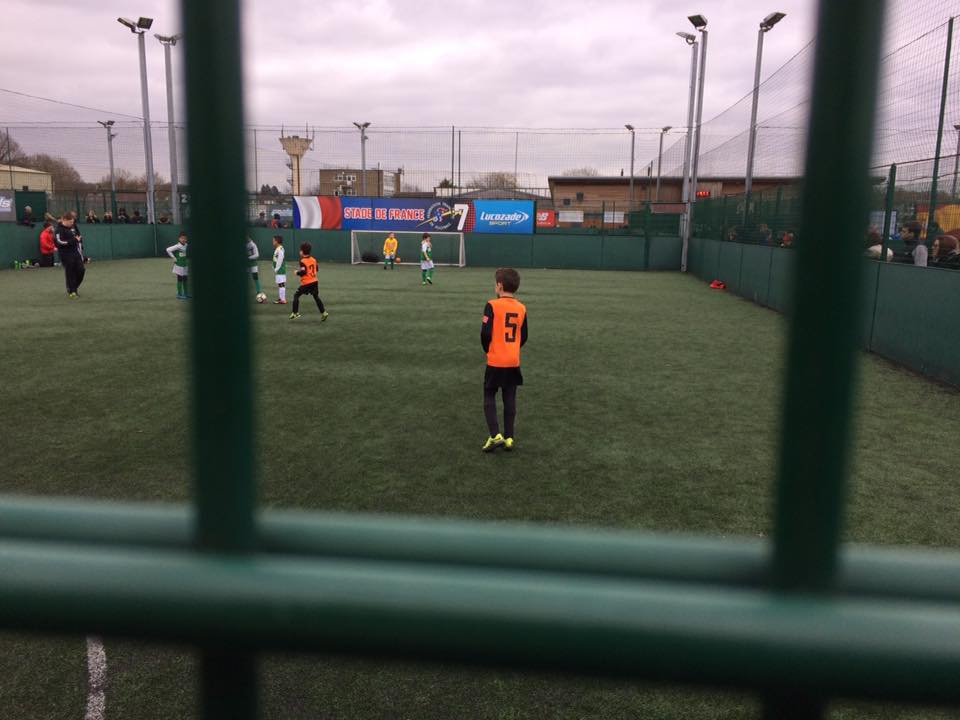
    We were privileged yesterday to walk only a few yards from the 5-a-side pitch of the Stade de France to the Izmailovo district of Moscow for a 7-a-side match in the territory of Okrug.

    It was surprisingly easy to enter Russia; we didn’t need a Visa or to visit Kensington for a biometric scan at the Consulate. We were spared a punishing drive through Poland and the marshes of Belarus, a trip which may have seemed excessive given that we were up against another team from the market town of Wokingham. Also, once in Russia proper, how tempting would it have been to have gone further, perhaps nipping up to St. Petersburg to commence the cult overland drive to Beijing via Kazakhstan and Mongolia with friendlies in the discontinuous permafrost and conifer forests of the Asian Drainage Basin to tune ourselves up for China.

    I digress. A nod from the superintendent of the Berkshire Youth Development League supersedes the authority of the Kremlin, no matter how many third-party tracking cookies they use to monitor the fixtures.

    The bigger pitch meant that all players could play for the entirety of the game, and hopefully find some sort of rhythm rather than being rotated like priests in a tricky parish. This meant that instead of players such as leitwolf Connor Mulvaney taking a step and popping a shot off, they would weave ever more agonic, convoluted lines in an effort to outwit flocking defenders, whereas if they had put a foot on the ball and looked up, they could have played the ball into a space as expansive as the southern Gobi.

    In other words, they seemed to regress a bit on a bigger pitch, running around after the ball in typical novitiate style, forming patterns more akin to rolling mauls than recognisable football formations. I think this is because standing in space on a larger pitch doesn’t feel like the dangerous position it truly is, but simply an intolerable and pointless remove from the action.

    The beginning of the game means only one thing for Wokingham & Emmbrook Oranges: conceding goals, as certainly as the earth zips round the sun. It’s just a given, despite all coaching to the contrary. The ref runs the tap and we scramble for the plug: every week. So, it was 1-0 before you could say ‘potato’ and 2-0 before you could add ‘salad.’ However – and this is the strange thing – before you could then say:

    1. Preheat oven to 200 C.
    2. Wash and halve eggplants and place in preheated oven for 20-25 mins until soft.
    3. Scoop out the insides of the baked eggplant and place in a blender.
    4. Add lemon juice, garlic, tahini, salt & pepper and blend for a minute or so until all the ingredients are well combined.
    5. Scoop out the baba ganoush from the blender into a bowl. Gently stir in yogurt (optional) and extra salt & pepper if needed.
    6. Drizzle with olive oil and a sprinkle of cracked pepper before serving.
    7. Store in the fridge for up to 3 days.

    …no more goals had been conceded. In fact, you could have said:

    “JOHN, by the grace of God King of England, Lord of Ireland, Duke of Normandy and Aquitaine, and Count of Anjou, to his archbishops, bishops, abbots, earls, barons, justices, foresters, sheriffs, stewards, servants, and to all his officials and loyal subjects, Greeting.

    KNOW THAT BEFORE GOD, for the health of our soul and those of our ancestors and heirs, to the honour of God, the exaltation of the holy Church, and the better ordering of our kingdom, at the advice of our reverend fathers Stephen, archbishop of Canterbury, primate of all England, and cardinal of the holy Roman Church, Henry archbishop of Dublin, William bishop of London, Peter bishop of Winchester, Jocelin bishop of Bath and Glastonbury, Hugh bishop of Lincoln, Walter bishop of Worcester, William bishop of Coventry, Benedict bishop of Rochester, Master Pandulf subdeacon and member of the papal household, Brother Aymeric master of the knighthood of the Temple in England, William Marshal earl of Pembroke, William earl of Salisbury, William earl of Warren, William earl of Arundel, Alan of Galloway constable of Scotland, Warin fitz Gerald, Peter fitz Herbert, Hubert de Burgh seneschal of Poitou, Hugh de Neville, Matthew fitz Herbert, Thomas Basset, Alan Basset, Philip Daubeny, Robert de Roppeley, John Marshal, John fitz Hugh, and other loyal subjects:

    + (1) FIRST, THAT WE HAVE GRANTED TO GOD, and by this present charter have confirmed for us and our heirs in perpetuity, that the English Church shall be free, and shall have its rights undiminished, and its liberties unimpaired. That we wish this so to be observed, appears from the fact that of our own free will, before the outbreak of the present dispute between us and our barons, we granted and confirmed by charter the freedom of the Church’s elections – a right reckoned to be of the greatest necessity and importance to it – and caused this to be confirmed by Pope Innocent III. This freedom we shall observe ourselves, and desire to be observed in good faith by our heirs in perpetuity.

    TO ALL FREE MEN OF OUR KINGDOM we have also granted, for us and our heirs for ever, all the liberties written out below, to have and to keep for them and their heirs, of us and our heirs:

    (2) If any earl, baron, or other person that holds lands directly of the Crown, for military service, shall die, and at his death his heir shall be of full age and owe a ‘relief’, the heir shall have his inheritance on payment of the ancient scale of ‘relief’. That is to say, the heir or heirs of an earl shall pay £100 for the entire earl’s barony, the heir or heirs of a knight 100s. at most for the entire knight’s ‘fee’, and any man that owes less shall pay less, in accordance with the ancient usage of ‘fees’.

    (3) But if the heir of such a person is under age and a ward, when he comes of age he shall have his inheritance without ‘relief’ or fine.

    (4) The guardian of the land of an heir who is under age shall take from it only reasonable revenues, customary dues, and feudal services. He shall do this without destruction or damage to men or property. If we have given the guardianship of the land to a sheriff, or to any person answerable to us for the revenues, and he commits destruction or damage, we will exact compensation from him, and the land shall be entrusted to two worthy and prudent men of the same ‘fee’, who shall be answerable to us for the revenues, or to the person to whom we have assigned them. If we have given or sold to anyone the guardianship of such land, and he causes destruction or damage, he shall lose the guardianship of it, and it shall be handed over to two worthy and prudent men of the same ‘fee’, who shall be similarly answerable to us.

    (5) For so long as a guardian has guardianship of such land, he shall maintain the houses, parks, fish preserves, ponds, mills, and everything else pertaining to it, from the revenues of the land itself. When the heir comes of age, he shall restore the whole land to him, stocked with plough teams and such implements of husbandry as the season demands and the revenues from the land can reasonably bear.

    (6) Heirs may be given in marriage, but not to someone of lower social standing. Before a marriage takes place, it shall be made known to the heir’s next-of-kin.

    (7) At her husband’s death, a widow may have her marriage portion and inheritance at once and without trouble. She shall pay nothing for her dower, marriage portion, or any inheritance that she and her husband held jointly on the day of his death. She may remain in her husband’s house for forty days after his death, and within this period her dower shall be assigned to her.

    (8) No widow shall be compelled to marry, so long as she wishes to remain without a husband. But she must give security that she will not marry without royal consent, if she holds her lands of the Crown, or without the consent of whatever other lord she may hold them of.

    (9) Neither we nor our officials will seize any land or rent in payment of a debt, so long as the debtor has movable goods sufficient to discharge the debt. A debtor’s sureties shall not be distrained upon so long as the debtor himself can discharge his debt. If, for lack of means, the debtor is unable to discharge his debt, his sureties shall be answerable for it. If they so desire, they may have the debtor’s lands and rents until they have received satisfaction for the debt that they paid for him, unless the debtor can show that he has settled his obligations to them.

    * (10) If anyone who has borrowed a sum of money from Jews dies before the debt has been repaid, his heir shall pay no interest on the debt for so long as he remains under age, irrespective of whom he holds his lands. If such a debt falls into the hands of the Crown, it will take nothing except the principal sum specified in the bond.

    * (11) If a man dies owing money to Jews, his wife may have her dower and pay nothing towards the debt from it. If he leaves children that are under age, their needs may also be provided for on a scale appropriate to the size of his holding of lands. The debt is to be paid out of the residue, reserving the service due to his feudal lords. Debts owed to persons other than Jews are to be dealt with similarly.

    * (12) No ‘scutage’ or ‘aid’ may be levied in our kingdom without its general consent, unless it is for the ransom of our person, to make our eldest son a knight, and (once) to marry our eldest daughter. For these purposes only a reasonable ‘aid’ may be levied. ‘Aids’ from the city of London are to be treated similarly.

    + (13) The city of London shall enjoy all its ancient liberties and free customs, both by land and by water. We also will and grant that all other cities, boroughs, towns, and ports shall enjoy all their liberties and free customs.

    * (14) To obtain the general consent of the realm for the assessment of an ‘aid’ – except in the three cases specified above – or a ‘scutage’, we will cause the archbishops, bishops, abbots, earls, and greater barons to be summoned individually by letter. To those who hold lands directly of us we will cause a general summons to be issued, through the sheriffs and other officials, to come together on a fixed day (of which at least forty days notice shall be given) and at a fixed place. In all letters of summons, the cause of the summons will be stated. When a summons has been issued, the business appointed for the day shall go forward in accordance with the resolution of those present, even if not all those who were summoned have appeared.

    * (15) In future we will allow no one to levy an ‘aid’ from his free men, except to ransom his person, to make his eldest son a knight, and (once) to marry his eldest daughter. For these purposes only a reasonable ‘aid’ may be levied.

    (16) No man shall be forced to perform more service for a knight’s ‘fee’, or other free holding of land, than is due from it.

    (17) Ordinary lawsuits shall not follow the royal court around, but shall be held in a fixed place.

    (18) Inquests of novel disseisin, mort d’ancestor, and darrein presentment shall be taken only in their proper county court. We ourselves, or in our absence abroad our chief justice, will send two justices to each county four times a year, and these justices, with four knights of the county elected by the county itself, shall hold the assizes in the county court, on the day and in the place where the court meets.

    (19) If any assizes cannot be taken on the day of the county court, as many knights and freeholders shall afterwards remain behind, of those who have attended the court, as will suffice for the administration of justice, having regard to the volume of business to be done.

    (20) For a trivial offence, a free man shall be fined only in proportion to the degree of his offence, and for a serious offence correspondingly, but not so heavily as to deprive him of his livelihood. In the same way, a merchant shall be spared his merchandise, and a villein the implements of his husbandry, if they fall upon the mercy of a royal court. None of these fines shall be imposed except by the assessment on oath of reputable men of the neighbourhood.

    (21) Earls and barons shall be fined only by their equals, and in proportion to the gravity of their offence.

    (22) A fine imposed upon the lay property of a clerk in holy orders shall be assessed upon the same principles, without reference to the value of his ecclesiastical benefice.

    (23) No town or person shall be forced to build bridges over rivers except those with an ancient obligation to do so.

    (24) No sheriff, constable, coroners, or other royal officials are to hold lawsuits that should be held by the royal justices.

    * (25) Every county, hundred, wapentake, and tithing shall remain at its ancient rent, without increase, except the royal demesne manors.

    (26) If at the death of a man who holds a lay ‘fee’ of the Crown, a sheriff or royal official produces royal letters patent of summons for a debt due to the Crown, it shall be lawful for them to seize and list movable goods found in the lay ‘fee’ of the dead man to the value of the debt, as assessed by worthy men. Nothing shall be removed until the whole debt is paid, when the residue shall be given over to the executors to carry out the dead man’s will. If no debt is due to the Crown, all the movable goods shall be regarded as the property of the dead man, except the reasonable shares of his wife and children.

    * (27) If a free man dies intestate, his movable goods are to be distributed by his next-of-kin and friends, under the supervision of the Church. The rights of his debtors are to be preserved.

    (28) No constable or other royal official shall take corn or other movable goods from any man without immediate payment, unless the seller voluntarily offers postponement of this.

    (29) No constable may compel a knight to pay money for castle-guard if the knight is willing to undertake the guard in person, or with reasonable excuse to supply some other fit man to do it. A knight taken or sent on military service shall be excused from castle-guard for the period of this service.

    (30) No sheriff, royal official, or other person shall take horses or carts for transport from any free man, without his consent.

    (31) Neither we nor any royal official will take wood for our castle, or for any other purpose, without the consent of the owner.

    (32) We will not keep the lands of people convicted of felony in our hand for longer than a year and a day, after which they shall be returned to the lords of the ‘fees’ concerned.

    (33) All fish-weirs shall be removed from the Thames, the Medway, and throughout the whole of England, except on the sea coast.

    (34) The writ called precipe shall not in future be issued to anyone in respect of any holding of land, if a free man could thereby be deprived of the right of trial in his own lord’s court.

    (35) There shall be standard measures of wine, ale, and corn (the London quarter), throughout the kingdom. There shall also be a standard width of dyed cloth, russet, and haberject, namely two ells within the selvedges. Weights are to be standardised similarly.

    (36) In future nothing shall be paid or accepted for the issue of a writ of inquisition of life or limbs. It shall be given gratis, and not refused.

    (37) If a man holds land of the Crown by ‘fee-farm’, ‘socage’, or ‘burgage’, and also holds land of someone else for knight’s service, we will not have guardianship of his heir, nor of the land that belongs to the other person’s ‘fee’, by virtue of the ‘fee-farm’, ‘socage’, or ‘burgage’, unless the ‘fee-farm’ owes knight’s service. We will not have the guardianship of a man’s heir, or of land that he holds of someone else, by reason of any small property that he may hold of the Crown for a service of knives, arrows, or the like.

    (38) In future no official shall place a man on trial upon his own unsupported statement, without producing credible witnesses to the truth of it.

    + (39) No free man shall be seized or imprisoned, or stripped of his rights or possessions, or outlawed or exiled, or deprived of his standing in any way, nor will we proceed with force against him, or send others to do so, except by the lawful judgment of his equals or by the law of the land.

    + (40) To no one will we sell, to no one deny or delay right or justice.

    (41) All merchants may enter or leave England unharmed and without fear, and may stay or travel within it, by land or water, for purposes of trade, free from all illegal exactions, in accordance with ancient and lawful customs. This, however, does not apply in time of war to merchants from a country that is at war with us. Any such merchants found in our country at the outbreak of war shall be detained without injury to their persons or property, until we or our chief justice have discovered how our own merchants are being treated in the country at war with us. If our own merchants are safe they shall be safe too.

    * (42) In future it shall be lawful for any man to leave and return to our kingdom unharmed and without fear, by land or water, preserving his allegiance to us, except in time of war, for some short period, for the common benefit of the realm. People that have been imprisoned or outlawed in accordance with the law of the land, people from a country that is at war with us, and merchants – who shall be dealt with as stated above – are excepted from this provision.

    (43) If a man holds lands of any ‘escheat’ such as the ‘honour’ of Wallingford, Nottingham, Boulogne, Lancaster, or of other ‘escheats’ in our hand that are baronies, at his death his heir shall give us only the ‘relief’ and service that he would have made to the baron, had the barony been in the baron’s hand. We will hold the ‘escheat’ in the same manner as the baron held it.

    (44) People who live outside the forest need not in future appear before the royal justices of the forest in answer to general summonses, unless they are actually involved in proceedings or are sureties for someone who has been seized for a forest offence.

    * (45) We will appoint as justices, constables, sheriffs, or other officials, only men that know the law of the realm and are minded to keep it well.

    (46) All barons who have founded abbeys, and have charters of English kings or ancient tenure as evidence of this, may have guardianship of them when there is no abbot, as is their due.

    (47) All forests that have been created in our reign shall at once be disafforested. River-banks that have been enclosed in our reign shall be treated similarly.

    *(48) All evil customs relating to forests and warrens, foresters, warreners, sheriffs and their servants, or river-banks and their wardens, are at once to be investigated in every county by twelve sworn knights of the county, and within forty days of their enquiry the evil customs are to be abolished completely and irrevocably. But we, or our chief justice if we are not in England, are first to be informed.

    * (49) We will at once return all hostages and charters delivered up to us by Englishmen as security for peace or for loyal service.

    * (50) We will remove completely from their offices the kinsmen of Gerard de Athée, and in future they shall hold no offices in England. The people in question are Engelard de Cigogné, Peter, Guy, and Andrew de Chanceaux, Guy de Cigogné, Geoffrey de Martigny and his brothers, Philip Marc and his brothers, with Geoffrey his nephew, and all their followers.

    * (51) As soon as peace is restored, we will remove from the kingdom all the foreign knights, bowmen, their attendants, and the mercenaries that have come to it, to its harm, with horses and arms.

    * (52) To any man whom we have deprived or dispossessed of lands, castles, liberties, or rights, without the lawful judgment of his equals, we will at once restore these. In cases of dispute the matter shall be resolved by the judgment of the twenty-five barons referred to below in the clause for securing the peace (§61). In cases, however, where a man was deprived or dispossessed of something without the lawful judgment of his equals by our father King Henry or our brother King Richard, and it remains in our hands or is held by others under our warranty, we shall have respite for the period commonly allowed to Crusaders, unless a lawsuit had been begun, or an enquiry had been made at our order, before we took the Cross as a Crusader. On our return from the Crusade, or if we abandon it, we will at once render justice in full.

    * (53) We shall have similar respite in rendering justice in connexion with forests that are to be disafforested, or to remain forests, when these were first afforested by our father Henry or our brother Richard; with the guardianship of lands in another person’s ‘fee’, when we have hitherto had this by virtue of a ‘fee’ held of us for knight’s service by a third party; and with abbeys founded in another person’s ‘fee’, in which the lord of the ‘fee’ claims to own a right. On our return from the Crusade, or if we abandon it, we will at once do full justice to complaints about these matters.

    (54) No one shall be arrested or imprisoned on the appeal of a woman for the death of any person except her husband.

    * (55) All fines that have been given to us unjustly and against the law of the land, and all fines that we have exacted unjustly, shall be entirely remitted or the matter decided by a majority judgment of the twenty-five barons referred to below in the clause for securing the peace (§61) together with Stephen, archbishop of Canterbury, if he can be present, and such others as he wishes to bring with him. If the archbishop cannot be present, proceedings shall continue without him, provided that if any of the twenty-five barons has been involved in a similar suit himself, his judgment shall be set aside, and someone else chosen and sworn in his place, as a substitute for the single occasion, by the rest of the twenty-five.

    (56) If we have deprived or dispossessed any Welshmen of land, liberties, or anything else in England or in Wales, without the lawful judgment of their equals, these are at once to be returned to them. A dispute on this point shall be determined in the Marches by the judgment of equals. English law shall apply to holdings of land in England, Welsh law to those in Wales, and the law of the Marches to those in the Marches. The Welsh shall treat us and ours in the same way.

    * (57) In cases where a Welshman was deprived or dispossessed of anything, without the lawful judgment of his equals, by our father King Henry or our brother King Richard, and it remains in our hands or is held by others under our warranty, we shall have respite for the period commonly allowed to Crusaders, unless a lawsuit had been begun, or an enquiry had been made at our order, before we took the Cross as a Crusader. But on our return from the Crusade, or if we abandon it, we will at once do full justice according to the laws of Wales and the said regions.

    * (58) We will at once return the son of Llywelyn, all Welsh hostages, and the charters delivered to us as security for the peace.

    * (59) With regard to the return of the sisters and hostages of Alexander, king of Scotland, his liberties and his rights, we will treat him in the same way as our other barons of England, unless it appears from the charters that we hold from his father William, formerly king of Scotland, that he should be treated otherwise. This matter shall be resolved by the judgment of his equals in our court.

    (60) All these customs and liberties that we have granted shall be observed in our kingdom in so far as concerns our own relations with our subjects. Let all men of our kingdom, whether clergy or laymen, observe them similarly in their relations with their own men.

    * (61) SINCE WE HAVE GRANTED ALL THESE THINGS for God, for the better ordering of our kingdom, and to allay the discord that has arisen between us and our barons, and since we desire that they shall be enjoyed in their entirety, with lasting strength, for ever, we give and grant to the barons the following security:

    The barons shall elect twenty-five of their number to keep, and cause to be observed with all their might, the peace and liberties granted and confirmed to them by this charter.

    If we, our chief justice, our officials, or any of our servants offend in any respect against any man, or transgress any of the articles of the peace or of this security, and the offence is made known to four of the said twenty-five barons, they shall come to us – or in our absence from the kingdom to the chief justice – to declare it and claim immediate redress. If we, or in our absence abroad the chief justice, make no redress within forty days, reckoning from the day on which the offence was declared to us or to him, the four barons shall refer the matter to the rest of the twenty-five barons, who may distrain upon and assail us in every way possible, with the support of the whole community of the land, by seizing our castles, lands, possessions, or anything else saving only our own person and those of the queen and our children, until they have secured such redress as they have determined upon. Having secured the redress, they may then resume their normal obedience to us.

    Any man who so desires may take an oath to obey the commands of the twenty-five barons for the achievement of these ends, and to join with them in assailing us to the utmost of his power. We give public and free permission to take this oath to any man who so desires, and at no time will we prohibit any man from taking it. Indeed, we will compel any of our subjects who are unwilling to take it to swear it at our command.

    If one of the twenty-five barons dies or leaves the country, or is prevented in any other way from discharging his duties, the rest of them shall choose another baron in his place, at their discretion, who shall be duly sworn in as they were.

    In the event of disagreement among the twenty-five barons on any matter referred to them for decision, the verdict of the majority present shall have the same validity as a unanimous verdict of the whole twenty-five, whether these were all present or some of those summoned were unwilling or unable to appear.

    The twenty-five barons shall swear to obey all the above articles faithfully, and shall cause them to be obeyed by others to the best of their power.

    We will not seek to procure from anyone, either by our own efforts or those of a third party, anything by which any part of these concessions or liberties might be revoked or diminished. Should such a thing be procured, it shall be null and void and we will at no time make use of it, either ourselves or through a third party.

    * (62) We have remitted and pardoned fully to all men any ill-will, hurt, or grudges that have arisen between us and our subjects, whether clergy or laymen, since the beginning of the dispute. We have in addition remitted fully, and for our own part have also pardoned, to all clergy and laymen any offences committed as a result of the said dispute between Easter in the sixteenth year of our reign (i.e. 1215) and the restoration of peace.

    In addition we have caused letters patent to be made for the barons, bearing witness to this security and to the concessions set out above, over the seals of Stephen archbishop of Canterbury, Henry archbishop of Dublin, the other bishops named above, and Master Pandulf.

    * (63) IT IS ACCORDINGLY OUR WISH AND COMMAND that the English Church shall be free, and that men in our kingdom shall have and keep all these liberties, rights, and concessions, well and peaceably in their fullness and entirety for them and their heirs, of us and our heirs, in all things and all places for ever.

    Both we and the barons have sworn that all this shall be observed in good faith and without deceit. Witness the abovementioned people and many others.

    Given by our hand in the meadow that is called Runnymede, between Windsor and Staines, on the fifteenth day of June in the seventeenth year of our reign (i.e. 1215: the new regnal year began on 28 May)”…

    …and still no goals would have been scored. So why two were conceded in the opening minute and none after will have to remain one of the famous Rumsfeld unknowns.

    Once the plug was in, we began to find some shape and meaning, scoring twice after vision from Evan picked out Connor – once with a slide-rule pass through a littered Rangers defence and once with a run around the full-back, John Barnes style, before a measured pass across the box. Evan nearly added a winner when he curled a free-kick too high for the keeper to handle but just past the post, drawing gasps from the opposition crowd.

    His overall performance, though occasionally hindered by constriction of the bronchioles,   would have sent the Birds of Paradise Farm into rapture and was certainly enough for the Skills Trophy at the end of the game before the walk back from the Russian wastes, on into Woodley and off via automobile through Heston and beyond.

    17190765_10158323350600652_8997911190807267699_n-1


    March 5, 2017

  • Woodley Wanderers Scorpions 10 Wokingham & Emmbrook 4 (Mulvaney 3, Saynor)

    If the dank greyness of the Berkshire lowlands could lift, temporarily, maybe we’d see a buttery cue ball moon that’s all melted off to one side as a Thunderbird moves through Winnersh Triangle under a Muscatel sky.

    Having not won since December 17th, following a controversial new year promotion, Evan needed some pepping up, an infusion of emotional iron, hopes cantilevered ever higher, beyond the peaks and troughs of blood sugar and mere results, towards a genuine understanding of what it means to be alive and listening to Tom Waits.

    Tom is far better placed than me to offer a gee-up, so as we clanked through the fields of Hurst we turned to his electric reflection on the stars and stripes: ‘The sun is up, the world is flat, damn good address for a rat. Smoke is blacking out the sun/at night I pray and clean my gun…Hoist that Rag.’

    Evan observed that Tom had possibly been taking ‘wrong helium.’ Would Johnny Cash be better? ‘I went to sleep in Shreveport, woke up in Abilene, now I’m wondering why I’m wanted at some town halfway between.’ No. Crash Test Dummies? ‘I’ve tasted your best guacamole, siesta’d at noon in the cool of the soil…Sometimes it’s too hot for cooking.
    One wants just a salad. And then comes a breeze in the evening/ men light cigars and the scent fills the air.’ Not really. He wanted ‘Now Party Anthems’, but I just couldn’t find the CD.

    On The Stade de France pitch at The Goals Centre, the Woodley manager sniffed the air like an old warhorse as his team, ‘proud to be sponsored by Subway’, according to the club website, warmed up looking like mobile sandwich packets.

    We hadn’t played this team before, but word on the bush telegraph was that they sought dominion over the whole of Woodley from Waingels Road to South Lake and most particularly over Emma Saynor’s Woodley Zebras, their arch-rivals, whom they wished to consign to the shade of Beechwood Avenue and the mature specimens lining it.

    Far from the varlets, firkin hurlers and sourbummed coaches of Theale we lost to last week, Woodley at least offered intermittent nods to decency as they passed and moved like celtic fast food. True, their hefty keeper – stars shaven into his round head – considered it acceptable to shoot from his goal kicks, in contravention of the spirit of the game and Andre Villas Boas. True, they routinely pinched the ball whenever it was a Wokingham throw-in, but they weren’t  violent as an expression of club policy, in contrast to both Reeves Rangers and Theale who launched aerial assault after aerial assault while we tried in vain to beat them on the carpet, opting for the Schleiffen plan by pressing down the flanks while they bombarded our goalmouth from the air.

    As well as Wokingham (mixed of ability, strength, gender and the extent to which their mental dolly mixtures make up a quarter) facing roughhouse tactics from the opposition, they also have to deal with a constant propensity to self destruct. The problem is, we don’t self destruct spectacularly, creating valuable collateral damage in the process, but tend to scuttle underwater quietly with a devastatingly poor back pass or catatonic roll from the ‘keeper. Not for us the moral assault of a Zidane or Cantona, the dubious blaze of glory or ‘divine wind’ of a kung-fu kick at the green mesh corralling irritating parents.

    No useful point is made by a miscontrolled pass or a ball played into the path of an attacker: bland mistakes create no shrapnel, as they say, but in this instance they did put us 3-0 down within two minutes.

    A period of relative stability ensued as Wokingham rallied, led by a heavily gloved, hatted and talented Connor Mulvaney who managed to forge a meandering course through the Woodley defence and fire us emphatically into contention. He’d gone for ski-gloves rather than a typical Thinsulate number. Our defence remained soft. If styles of play were  characterised as ice creams, Woodley’s would be play-doh: radioactive, luminescent, following no known recipe. Wokingham’s would be a sundae with all the jazzed-up garnish exploding on the taste buds to hide the Mr Whippy within.

    Evan was off the pitch in the first half, having entered into intensive bargaining with Coach Peter to exempt himself from goalkeeping duties. When he entered, mummy and Iris had appeared from the mists of the Loddon to yell  inverse-invective. In Iris’s case, this ranged wildly in the space of seconds: ‘Look! There’s Evan! Number 5! Come on, Evan…Can we go home in a bit?’ As is typically the case when family and friends come to watch, their presence was talismanic and Evan was soon picking up the ball with a view to making a meaningful impression on the game, pinging off quick passes and getting into space. This tactic bore notable fruit when he eluded the Woodley defence and scored having been picked out from a long throw.

    Ultimately though, it was back to the cross channel ferry bar to reflect again over coffee, bacon rolls and all sorts of vending machine nonsense on another lesson in the dark arts of success in Woodley.

    16864299_10158289052065652_281157526886821638_n

    February 26, 2017

Previous Page Next Page

Website Powered by WordPress.com.


Loading Comments...
 

    • Subscribe Subscribed
      • Wilderspool Causeway
      • Already have a WordPress.com account? Log in now.
      • Wilderspool Causeway
      • Subscribe Subscribed
      • Sign up
      • Log in
      • Report this content
      • View site in Reader
      • Manage subscriptions
      • Collapse this bar